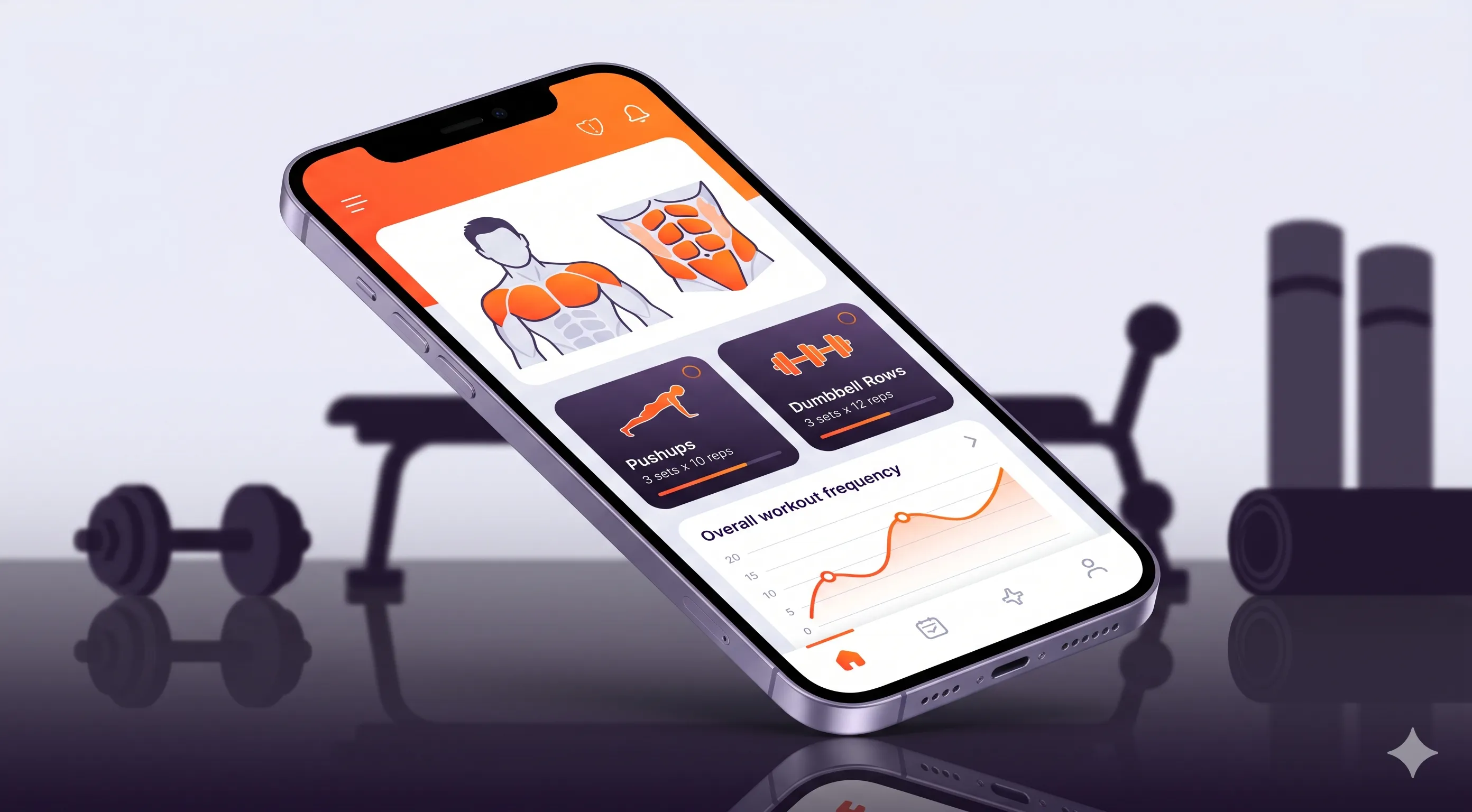
Volo
A gym companion app for building workout routines by body section, tracking nutrition, viewing exercise tutorials with targeted muscle groups, and recording weight progress over time.
Overview
Volo is a mobile-first gym companion designed to remove the guesswork from training. It helps users build structured routines, follow exercise tutorials with muscle group targeting, track nutritional intake, and visualize their weight progress over time — all in one streamlined app.
The gym shouldn’t require a personal trainer to navigate. Volo puts expert-level routine building in everyone’s pocket.
The Problem
Most gym-goers face a common set of frustrations:
- No structure — Walking into the gym without a plan leads to random, ineffective workouts
- Information overload — Hundreds of exercises exist, but which ones target what you need?
- Fragmented tools — Separate apps for routines, nutrition, and progress tracking creates friction
- No progression — Without tracking weight over time, it’s impossible to know if you’re improving
I wanted a single app that addresses all four problems with a clean, distraction-free mobile experience.
Goals
- Build a cross-platform mobile app with Flutter for iOS and Android
- Design a routine builder organized by body sections (push, pull, legs, etc.)
- Include exercise tutorials with animated muscle group highlighting
- Implement a nutrition tracker with macro breakdowns
- Create a weight progress log with visual trend charts
- Deliver a fast, offline-capable experience for gym environments
Tech Stack
| Technology | Role |
|---|---|
| Flutter | Cross-platform mobile UI framework |
| Dart | Application logic and state management |
| FastAPI | Python backend for API and data processing |
| PostgreSQL | Database for users, routines, and exercise library |
| SQLite | Local device storage for offline support |
| Matplotlib | Server-side progress chart generation |
Architecture
┌──────────────────┐     ┌──────────────────┐     ┌──────────────┐
│   Flutter App    │────▶│   FastAPI        │────▶│  PostgreSQL  │
│   (iOS/Android)  │◀────│   /api/v1/*      │◀────│              │
└────────┬─────────┘     └──────────────────┘     └──────────────┘
         │
         ▼
┌──────────────────┐
│   SQLite Local   │
│   (Offline Cache)│
└──────────────────┘
The app follows an offline-first strategy — routines and exercise data sync to local SQLite on first load. Users can complete full workouts without connectivity; data syncs when connection resumes.
Key Features
Routine Builder by Body Section
Users create routines organized by muscle group targeting:
| Section | Example Exercises |
|---|---|
| Push | Bench press, overhead press, tricep dips |
| Pull | Deadlift, barbell rows, pull-ups |
| Legs | Squats, leg press, Romanian deadlifts |
| Core | Planks, cable crunches, hanging leg raises |
| Arms | Bicep curls, skull crushers, hammer curls |
Each routine supports:
- Custom exercise ordering
- Set/rep/weight configuration per exercise
- Rest timer between sets
- Notes per exercise
Exercise Library with Tutorials
A comprehensive database of 200+ exercises, each featuring:
- Step-by-step text instructions
- Animated muscle group diagrams showing primary and secondary muscles
- Common mistakes to avoid
- Suggested alternatives for equipment limitations
Nutrition Tracker
Daily food logging with:
- Macro breakdown (protein, carbs, fats)
- Calorie tracking against daily targets
- Meal categorization (breakfast, lunch, dinner, snacks)
- Quick-add for frequently logged foods
- Weekly/monthly nutrition summaries
Weight Progress Tracking
A dedicated section for recording body weight over time:
- Daily weigh-in logging
- Trend line chart smoothing daily fluctuations
- Goal setting with projected timeline
- Weekly averages to reduce noise from water weight
- Progress photos timeline (optional)
Active Workout Mode
When a routine is started, the app enters a focused workout mode:
┌─────────────────────────────┐
│  Bench Press          3/4   │
│  ─────────────────────────  │
│  Set 1: 80kg × 10 ✓        │
│  Set 2: 85kg × 8  ✓        │
│  Set 3: 85kg × _  ← active │
│  Set 4: 80kg × 10           │
│  ─────────────────────────  │
│  Rest: 1:23 remaining       │
│  [Complete Set]             │
└─────────────────────────────┘
Challenges & Solutions
Challenge: Offline-First Data Sync
Gym environments have notoriously poor connectivity. The app needed to work fully offline, then sync without data loss or conflicts.
Solution: Implemented a last-write-wins sync strategy with timestamp-based conflict resolution. Local SQLite stores all workout data with a synced flag. A background isolate attempts sync every 30 seconds when connectivity is available. Critical operations (creating routines, logging sets) never depend on network.
Challenge: Muscle Group Visualization
Showing which muscles an exercise targets required clear, consistent anatomical illustrations that respond to the selected exercise.
Solution: Created a set of SVG body maps with individually addressable muscle groups. Each exercise maps to primary (highlighted) and secondary (dimmed) muscle IDs. Flutter’s SVG rendering paints the relevant groups, producing a clear visual without requiring dozens of individual illustrations.
Challenge: Flutter State Management at Scale
As features grew (routines + nutrition + progress + workout mode), managing state across the app became complex.
Solution: Adopted Riverpod for dependency injection and state management. Each feature domain has its own providers with clear boundaries. The active workout state uses a StateNotifier that persists to local storage, surviving app kills mid-workout.
Challenge: Rest Timer Accuracy
A rest timer that drifts or stops when the app is backgrounded is useless in a real gym scenario.
Solution: Used Flutter’s Isolate for timer computation and local notifications for background alerts. The timer calculates remaining time from a stored start timestamp rather than counting down, ensuring accuracy regardless of app lifecycle events.
Data Model (Simplified)
class Routine(BaseModel):
    id: UUID
    user_id: UUID
    name: str
    section: str  # "push" | "pull" | "legs" | "core" | "arms"
    exercises: list[RoutineExercise]

class RoutineExercise(BaseModel):
    exercise_id: UUID
    order: int
    sets: int
    target_reps: int
    target_weight: float | None
    rest_seconds: int

class WorkoutLog(BaseModel):
    id: UUID
    routine_id: UUID
    started_at: datetime
    completed_at: datetime | None
    sets: list[SetLog]

class SetLog(BaseModel):
    exercise_id: UUID
    set_number: int
    weight: float
    reps: int
    completed_at: datetime
Performance
| Metric | Target | Achieved |
|---|---|---|
| App cold start | < 2s | 1.4s |
| Routine load (offline) | < 100ms | 45ms |
| Sync cycle | < 3s | ~1.8s |
| Exercise search | < 200ms | 90ms |
| Frame rate (animations) | 60fps | 60fps |
Lessons Learned
- Offline-first changes everything — Designing for offline from day one is vastly easier than retrofitting. It forces clean separation between local state and remote truth.
- Flutter + FastAPI is a great combo — Flutter’s hot reload speed and FastAPI’s auto-generated OpenAPI docs make the development loop extremely fast.
- Gym UX needs big touch targets — Sweaty hands and quick glances between sets mean buttons need to be large, contrast needs to be high, and interactions need to be forgiving.
- SVG muscle maps scale beautifully — One set of vector assets works across all screen sizes and densities, with programmatic coloring replacing dozens of static images.
- Rest timers are deceptively complex — Background execution, notification permissions, and timer accuracy across OS lifecycle events required more engineering than expected.
What’s Next
- Social features (share routines, follow friends’ progress)
- AI-powered routine suggestions based on goals and history
- Apple Watch / Wear OS companion for active workout tracking
- Exercise form check via device camera and pose estimation
- Integration with smart scales for automatic weight logging